
establish a wild-derived, native, ecotypic seed source
No one gardens better than Mother Nature. Her designs are exquisite, and the connections between plants, insects, and animals that she has forged result from countless generations of evolution. The consequence of this process is biodiversity, as measured not only in species richness, but also in genetic richness. Uli Lorimer
Why ReSeeding Rhode Island?
As native plant enthusiasts, we have long advocated the importance of native plants to create ecologically biodiverse habitats, ones that will support the local bugs, bees, and butterflies, the beasts and birds that depend on them — even the microbes and fungi dwelling in the soil.
Not all plants labeled “native,” however, contribute equally to this rich and intricate web of interdependent relationships that are a function of the coevolution of our local flora and fauna. Ecotype plants, those sourced from historically local native plant populations in an ecoregion, are uniquely genetically suited to the biotic and abiotic environments of their particular region.
We are still learning about ecotypes and magic of seeds so don’t know all the answers. But we do know that the more genetic diversity within and between populations of native species, the better the chances that species will thrive through times of dramatic change or prolonged stress.
Reseeding RI is an ambitious plant to increase the availablity of our ecotype seeds and plants.
Goals
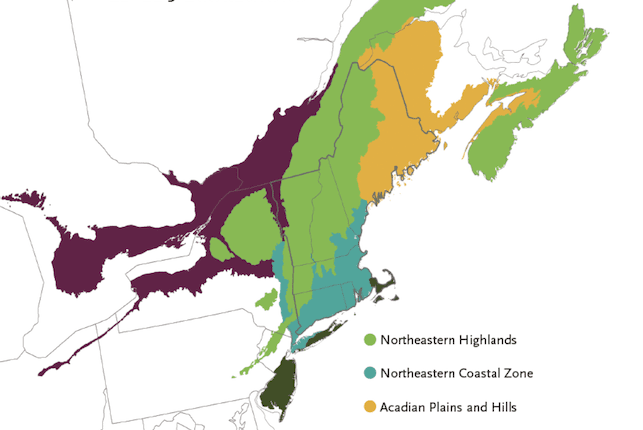
New England Ecoregions,(photo Native Plant Trust Garden Finder). The Environmental Protection Agency has mapped 105 ecoregions on the continental US, designating areas that share largely similar environmental conditions and plant genetics. Most of Rhode Island belongs in Northeast Coast Zone (Ecoregion 59).
The Seeds of ReSeeding Rhode Island
Our ambitious, multi-year initiative builds on work started in 2010 by botanist Hope Leeson on the Rhody Native Initiative of the Rhode Island Natural History Survey. We have also drawn heavily from the model of The Ecotype Project for Pollinator Health, set up in 2019 by The Northeast Organic Farming Association of Connecticut (CTNOFA) — now the Ecotype Project.
Our Journey
During the 2022 growing season, Botanist Shannon Kingsley collected seeds from a number of wild plant populations in an ethical and sustainable manner. These were cleaned and “winter sowed.” During the 2023 growing season the plugs grew strong, thanks to the nurturing of our horticulturist, Barbara Shaughnessy. In fall of 2023, plugs of 15 species were placed in “foundation plots” on the lands of our partner organic famers and land trusts. The first harvest of these seeds was realized in 2024. Seeds from some of these plants are now available.
We continue to collect seeds from wild plant populations, as a source to replenish existing foundation plots and to start new ones.
Re Seeding RI has partnered with Northeast Seed Collective to sell our seeds!
(keep scrolling for details!)
Check our events listing page for upcoming events where our seeds will be available, including at our 2026 Spring and Fall sales.
Additional resources about ReSeeding RI • The beginnings of the initiative, Reseeding RI, WildfloraRI, Spring 2022 • The value of ecotypic seeds, The Hype about Ecotype, WildforaRI, Winter 2023• Collecting seeds in the field, Our Botanist in the Field, WildfloraRI, Winter 2022
Northeast Seed Collective is offering 10 species of ReSeeding RI Seed and more to come!

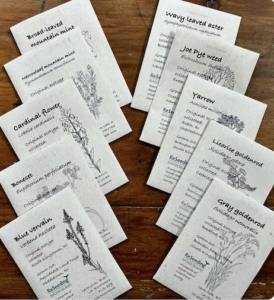
ReSeeding RI seeds. Healthy habitats start with local genetics.
Buy and grow the first generation progeny seeds of wild plant populations to
> protect our wild populations of native plants that are under pressure
> create greater biodiversity in our gardens and communities.
Species list: licorice goldenrod, yarrow, Joe Pye weed, wavy leaved aster, blue vervain, boneset, cardinal flower, narrowleaf mountain mint, broadleaf mountain mint, gray goldenrod
Special Sale. 20% OFF on RHODE ISLAND PRIDE BUNDLE. One packet each of all 10 species of ReSeeding RI seeds.
Northeast Seed Collective also uses ReSeeding RI ecotypic seeds in their custom seed mixes!
Together, we can protect and enhance biodiversity, safeguarding it from the growing threats of habitat loss and climate change.
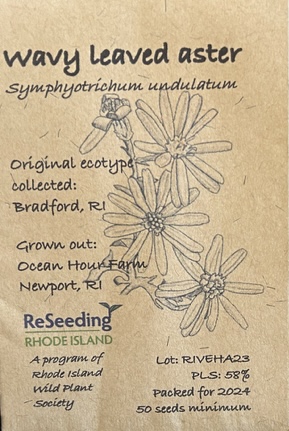
ReSeeding RI: Replenishing Rhode Island’s Native Plants
Recording of online presentation by Dave Vissoe, vice president of RIWPS and URI Master Garden, offered by University of Rhode Island Continuing Education – URI Cooperative Extension, February 25, 2024
First harvest of ecotypic seeds from our foundation plots!
Learn how we collect seeds from common yarrow.