Tag Archive for: native plants

Sale on ReSeeding RI Seeds 20% off!

The Northeast Seed Collective is proudly offers Rhode Island Pride, a bundle of 10 species of ReSeeding RI seeds.  These are first generation seed from wild plant populations in RI. ReSeeding RI, an initiative of Rhode Island Wild Plant Society follows ethical and sustainable seed collecting and growing practices.

Paradigm of Change

By Anne Raver

This article first appeared in our WildfloraRI Fall 2021

One hot, humid day in September 2020, the team of volunteers at the Trustom Pond National Wildlife Refuge in South Kingstown were awaiting a backhoe to dig the swales for the demonstration gardens they were building around the rustic cabin that serves as the refuge’s contact center. The backhoe never showed up, so they took up their shovels and moved the dirt by hand.  “With masks on, it was brutal,” recalled Mark Cordle, a RIWPS member and URI Master Gardener, who co-leads the project with Nick Ernst, USFWS wildlife biologist. Nick manages Trustom as well as the four other refuges within the RI National Wildlife Refuge Complex.

The volunteers laid down corrugated cardboard, soaked it, then shaped the mounds of soil — 15 cubic yards delivered from nearby Highland Farms. Janis Nepshinsky, who manages visitor services and outreach for the complex, purchased the weed-free soil and contributed earthmoving equipment. “Then we planted about 250 plants of 30 species in two days,” said Mark.

Group touring the restoration sites at Trustom Pond (photo ARaver)

A year later, a group of us from RIWPS were walking around the garden. Bumblebees nuzzled the yellow sneezeweed (Helenium autumnale) and white boneset thoroughwort (Eupatorium perfoliatum) still blooming in the rain garden. The garden now features close to 40 native species, including the sassafras and witch hazel already there and a beautiful old shadbush transplanted from nearby. Most of the plants were grown from seed collected from Kettle Pond.

That September afternoon, Dave Vissoe, who helped create this garden, leaned over a wavy-leaved aster (Symphyotrichum undulatum) eaten down to a nub by deer and nodded toward the white wood asters (Eurybia divaricata) next to the shadbush (Amelanchier sp.). “We’re hoping the wood asters will spread into the woods,” he said, gesturing to the trees to the north. But deer love asters of all kinds, so the team sprays them regularly with nontoxic repellents. On the other hand, broadleaved mountain mint (Pycnanthemum muticum) and the goldenrods are unpalatable to deer, so these were flourishing.

The plants are labeled, so as I watched a bumblebee on a goldenrod, I could identify the species — wreath goldenrod (Solidago caesia) — and remember how its tiny yellow flowers cluster in the leaf axils of the arching stems. I also studied how rocks were laid in a lined trench beneath the downspout that directs water off the cabin roof into the swales of the rain garden, where cardinal-flower (Lobelia cardinalis), swamp milkweed (Asclepias incarnata), bushy bluestem (Andropogon glomeratus), and other moisture-loving species were planted.

Dave had learned a bit about collecting seeds and propagating native plants from Hope Leeson, when she ran Rhody Native, an initiative of the Rhode Island Natural History Survey. He picked up the art of winter sowing from Peggy Buttenbaum, who has taught us how to turn plastic containers into mini-greenhouses. By the fall of 2018 the gardens at Kettle Pond were producing a bonanza of seeds — so volunteers collected them for winter sowing.  “We laid out a tarp in one of the classrooms, so we didn’t get potting soil everywhere,” said Dave. The volunteers poked holes in the plastic containers, planted the seeds, and took them home to sprout outdoors.  They then re-potted the thousands of resulting seedlings in Dave’s backyard and set them in an old dog pen no longer used his Jack Russells.  “We grew 500 to 1,000 plants the first year,” said Dave. “This year, we had a bumper crop of 5,000 plants.”

As the Kettle Pond gardens flourished, Dave set his sights on Trustom Pond, submitting a proposal to the URI Master Gardener program, which funded the project in March 2020. “Trustom is a special place to me,” Dave said. “When I was a kid, my parents and I would go to Moonstone Beach to swim and crab in Trustom Pond.” His parents ashes are scattered here. After launching the project, Dave and other early leaders stepped aside.

Mark and Nick are expanding the project into the grasslands behind the contact station. “Our mission is really to create awareness of the benefits of planting native species for habitat restoration,” said Mark. “The demo garden is a classroom where you can see all the species with labels. But it’s unnatural.” It’s also a gateway for 60,000 annual visitors, half of them birders. “There needs to be a paradigm change in our yards and landscapes,” said Nick. “These manicured lawns and nonnative shrubs are ecological deserts. But a lot of people think native plants are messy. The goal of the demo garden is to show folks how great it looks.”

Visitors might remember a few labelled plants – then recognize that same native species in one of four restoration sites along the trails. “People can see these plants spreading out in the natural environment,” said Nick, who paused by the tall grasses turning shades of purple, mahogany and orange.  He showed us how to tell the difference between big bluestem, whose flowering stalk resembles a turkey foot, and Indian grass, which is more of a feather. “Indian grass is rare in Rhode Island,” he said. “But most of the seed came from the Midwest.”

He explained why a seed isn’t just a seed: “The plants in New England have evolved for thousands of years with local growing conditions,” said Nick. “So if you use seed from the Midwest, the plants might not grow as well here, they might have differences in bloom times that might affect their pollinators.”

Restoring native species (photo MCordle)

In 1995 USFWS seeded the 15-acre field we were standing in with warm-season grasses intended to provide habitat for ground-nesting birds. However, “there are no songbirds nesting here, because it’s so dense,” said Nick. “It’s not really meeting our objectives.” It’s also too small an area for many bird species to reproduce. So Nick is shifting the goal here to creating  a diversity of native plant species that are larval hosts and nectar sources for insects, including moths and more than 38 species of native bees.

But where to get enough local genotype plants is the challenge. “We were getting plants from Hope Lesson, but the Rhode Island Natural History Survey is no longer doing Rhody Native,” Nick said. “The Master Gardener partnership has really filled that hole, by collecting seed from local plants and putting them back on the refuges. Early last year, Mark and Nick chose four restoration sites with different topography and soil and light conditions. Then, the crew of volunteers and USFWS interns started clearing the invasives. A Bobcat Skid Steer grinding up a tangle of multiflora rose and bush honeysuckle hit a wall, literally.

The low stone wall was a remnant of the farm that once belonged to Ann Kenyon Morse, a sheep breeder and keen horsewoman who also flew fighter planes as a WASP during World War II. In 1974, she donated 365 acres of land to USFWS, which was the start of the 787-acre Trustom Pond Refuge.

As the team pulled out grapevine and honeysuckle, they found black cherry and shadbush. Clethra, spirea, and swamp azaleas were blooming in the wetlands. One morning, Nick spotted a hummingbird clearwing moth, Hemaris thysbe, sipping nectar from a swamp azalea flower. They were puzzled by a large treelike shrub with mottled bark on the edge of the swamp. “I thought it was a viburnum at first,” said Mark, who snapped a few pictures for PictureThis. “It was a poison sumac. With a trunk 18” in diameter.”Its old limbs were leaning out from the edge of the boggy woods toward the sun, its leaves turning apricot-red.

The crew started planting in mid-August and worked through September, putting in about 5,000 plants sourced from Kettle Pond. Nick contributed 2,000 more, from Planter’s Choice Nursery in Connecticut. “I tried to get a variety of species the MG’s didn’t have, so they could use them for future seeds,” said Nick. “But I also got some of the same species, to increase genetic diversity. We don’t want to collect seeds from the same garden over and over.”

Nick and Dave had recently toured one of the Connecticut farms that are growing native plants for the Ecotype Project. Botanists collect seed from wild plants in ecoregion 59; organic farmers then grow out the seeds in ‘Founder Plots’; tens of thousands of seeds are then harvested from the plots and sent to nurseries. That basic model is exciting to restoration ecologists. “Maybe East Farm or organic farmers in Rhode Island could grow Founder Plots,” said Nick. I would love to see infrastructure in the Northeast to produce seeds in volume like they do in the Midwest.”

At some point, “if we wanted to transform the field at Trustom, we could plow up strips, then do no-till or broadcast seeds.” And this time the seed would be from this ecoregion, not the middle of the country.In the meantime, he and Mark will be interested to see how well the native species in the restoration areas establish. “Considering the bluestem and the thatch, it’s unlikely that they would without any kind of disturbance,” he said. “Maybe a prescribed burn or light tilling of soil would open up an avenue for those plants to spread.” But just having them flower and set seed in the restoration sites will increase the seed bank of local genotypes.

Mark took a break near a site where yellow thistle (Cirsium horridulum), rare to Rhode Island, was flourishing.  “To me, it’s like restoring an old historic house,” he said. “Only we’re restoring the plants that have been here for thousands of years.”

 

A Sense of Place: Kettle Pond

by Marnie Lacouture

This article first appeared in our publication WildfloraRI, Fall 2021

Dave Vissoe sharing his knowledge (photo PLacouture)

The native plant garden at the Kettle Pond Visitor Center in Charlestown had a serendipitous beginning. In 2016, Janis Nepshinsky, Visitor Services Manager for the U.S. Fish and Wildlife Service’s Rhode Island National Wildlife Refuge Complex, received a $5,000 grant to establish a native plant garden for pollinators.

The center, built in 2005, offers information on all five of the state’s National Wildlife Refuges — Trustom Pond, Sachuest Point, Ninigret, John H. Chafee, and Block Island – and also serves as a central office for the complex. It is located on the forested upland of the Ninigret refuge, north of Route 1. The Rhode Island glacier, which created the Charlestown terminal moraine approximately 20,000 years ago, left many kettle holes and ponds as the ice retreated. The name Kettle Pond refers to them.

For years, Janis had imagined creating a “sense of place,” by transforming the grassy area outside the center into a demonstration garden full of native plants and their pollinators, to show how biodiversity is necessary for the earth and its inhabitants. It would embody ‘mosoquotaash,’ a Narragansett word meaning ‘we are all connected.’

One slow day at the center, she noticed that Dave Vissoe, who was volunteering at the front desk, was poring over notes and books spread out on the table. “He said he was studying for a Master Gardener class,” recalled Janis. “I had just gotten this grant, and I thought, ‘Boy, have I got the garden for you!’” That is how Janis’s dream gained a project leader and became a reality.

Dave, who grew up in the south end of Hartford, CT, remembers his French grandfather as a gentle soul who was a serious gardener. As a young boy, Dave helped water in his grandfather’s greenhouse where the damp, earthy smell drew him to love gardening. He admits that he was not an earnest student and calls himself a “late, late, late bloomer.” Entering college right after high school, he soon dropped out to join the army, then returned after completing his service. It was at North Adams State College, now Massachusetts College of Liberal Arts, that he met Bev Mickey, his future wife. After graduating, Dave landed a job teaching high school biology and chemistry in Bennington, VT; Dave commuted to work while Bev finished her senior year. We can thank Bev for not liking the Vermont winters.

The couple moved to Rhode Island in 1970 where they both taught at Davisville Middle School in North Kingstown until 1977 when Dave was hired by Silver Burdett, a textbook publisher. There he used his science background and honed his management skills, living in Rhode Island as a national consultant until taking other positions that necessitated a move to New Jersey, where he and Bev raised their family. In 2013 Dave and a friend began to remodel the house that had belonged to his parents in Green Hill, a coastal community in South Kingstown. He and Bev moved back to the Ocean State and live there today.

Dave enjoys people and has a gift for bringing them together. He is quick to credit the accomplishments of others while modest about his own. Mary O’Connor, a Master Gardener as well as a Rhode Island Wild Plant Society board member, joined the Kettle Pond project shortly after it began and was instrumental in getting Dave to join the RIWPS board. She said his energy and passion are contagious, so he’s a pleasure to work with, a sentiment repeated by all the volunteers I spoke to. He is joyful and upbeat, and I always smile after a conversation with Dave, whether it is about his visiting grandson or a favorite plant.

In 2014 Dave’s appreciation of nature had drawn him to volunteer at both the U.S. Fish and Wildlife’s Trustom Pond refuge and the Kettle Pond Visitor Center. He became a Master Gardener in 2017 and dove immediately into the native plant garden project at Kettle Pond with Sharon Bridge, a veteran Master Gardener, as his coleader. Melissa Hughes and Darlene Trott each served for a time as coleader until 2019 when Erin Beuka, a Master Gardener who had recently moved to Rhode Island from New Jersey, took over. Dave describes her as a “powerhouse”, and Erin calls Dave a “dynamo.’ Erin is now maintaining the data bases originally created by Melissa from plot maps drawn on graph paper to track plant inventories and information. According to Dave, having this data has taken the garden to a higher level.

Native species grace the parking lot (photo DVissoe)

Dave’s many accomplishments have earned him The 2021 Rosanne Sherry Distinguished Educator Award from Master Gardeners.

Graham Gardner, a landscape designer and longtime RIWPS member, created a master plan for the garden consisting of several plots in various shapes and sizes before moving to Colorado. The plan was ultimately implemented by landscape designer Tysh McGrail, who had worked on many projects with him, promoting the use of native plants.

Volunteers prepared the beds, first removing invasive plants as well as poison ivy and maple saplings, then suppressing weeds with six layers of newspaper. Since the gardens were being planted over a septic system, they brought in weed-free loam to build up the soil. They pruned several overgrown winterberry shrubs (Ilex verticillata) that were growing along the building. They studied the prevailing wind, soil pH, and sun exposure to help match specific plants to the best spot. They laid out the curved plots with garden hoses and dug the edges deeply for neatness and to keep grass from growing into the paths. They layered the plants according to their height and bloom times.

Dave assembled an enthusiastic team for the first planting, which occurred over three days in mid-June of 2017. Nick Ernst, the FWS wildlife biologist for the refuge complex was there along with Janis, Tysh, several volunteers from Master Gardeners, April Alix and her summer intern Michael Bonilla from the Providence Parks Urban Wildlife Refuge Partnership, and members of the Rhode Island Wild Plant Society — twenty or so volunteers in all. Lorén Spears, a citizen of the Narragansett nation and executive director of the Tomaquag Museum, who had shared her knowledge of native plants and their uses by indigenous people, was also there on planting day. Although she was dressed for a later engagement, she couldn’t resist getting her hands dirty. Most of the plants, grown from locally sourced seeds, were obtained from Rhody Native, a RINHS project begun by botanist Hope Leeson. The rest came from a wholesale native plant nursery on Long Island.

A second planting was installed in October of 2017. The garden grew and the plants filled in as work continued in 2018 and 2019. In March of 2020, however, Covid restrictions meant that the garden would be tending itself until well into June, when volunteers returned to work practicing social distancing and wearing face masks. Dave continued to educate the public with video and Zoom presentations. Because he realized that the garden would be a source of comfort for many, he created safe guidelines for volunteers to work in small groups to keep the gardens weeded. The volunteers also installed a rain garden to the left of the visitor center entrance with a $2000 grant from RIWPS, although $750 was unused and returned.

An “adopt a plot” idea has been implemented recently in the hopes that maintenance will be manageable. Volunteers also can “adopt a plant,” learning all they can about it while tracking its growth in the garden. This information has been used to create a treasure hunt for school groups and as resource material for teachers, the general public, master and advanced gardeners, and garden clubs.

Butterfly milkweed seed pods (photo DVissoe)

In September, on one of the last days of summer, I visited the garden and was greeted by a tall clump of Indian grass (Sorghastrum nutans), the seed heads glowing in the afternoon sun. Goldenrods and asters were in their glory, abuzz with pollinators, and the fuel needed by the monarch butterflies for their long migratory trip was plentiful. The goldenrods included seaside (Solidago sempervirens), gray (S. nemoralis), wreath (S. caesia) and licorice (S. odora). There was an array of asters: wavy-leaved aster (Symphyotrichum undulatum), calico (S. lateriflorum) heart-leaved (S. cordifolium), New England (S. novae-angliae), and white wood aster (Eurybia divaricata). The pods of the butterfly weed (Asclepias tuberosa) were beginning to open, showing the white fluff of seeds inside, and the seed heads of the towering ironweed (Vernonia noveboracensis) were ripening. Little bluestem (Schizachyrium scoparium), a warm-season grass, was maturing to a lovely amber color. Several native vines, including trumpet honeysuckle (Lonicera sempervirens), common ground nut (Apios americana), and summer grape (Vitis aestivalis) were climbing the posts of a handsome curved arbor built by Rudi’s Rangers, a local volunteer group. Nearby, tree stumps were positioned in a semi-circle, as seating for an outdoor classroom.

As I wandered the paths, the dedication and work of so many was evident. Although the garden is still evolving, it had grown into one that demonstrates the importance of native plants to pollinators and other wildlife, as well as their beauty.

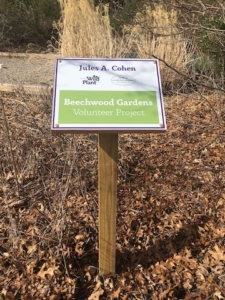
Beechwood Garden renamed in honor of Jules Cohen

by Dianne L. Izzo, RIWPS member and URI Master Gardener, who volunteers at the Beechwood Garden.

The North Kingstown Town Council granted the petition of the North Kingstown Senior Association (NKSA) to rename the Beechwood Gardens The Jules A. Cohen Gardens at the regular Council meeting on April 4, 2022. Mr. Cohen is Past President of the Master Gardeners and the Wild Plant Society, as well as Past President of the NKSA.

The Garden concept was originally proposed by Mr. Cohen in 2010, and as soon as the NKSA approved the proposal, he led the effort to make the gardens a reality by taking the following actions:

• Organized the approval, design, implementation, installation, maintenance and funding of the gardens

• Solicited licensed landscape architects, volunteers from the community, the URI Master Gardener program and the RI Wild Plant Society, and,

• Through a formal Memorandum of Agreement with the Master Gardeners and Wild Plant Society, obtained a commitment to maintain the gardens with regularly scheduled work sessions.

In addition, Mr. Cohen has —

• Established guidelines for the planting of native trees and shrubs with advice from experts

Volunteers working on April 21, 2022 (left to right) are Dona Giglio, Jules A. Cohen, Mary Lou Upham, Linda Solitto (in front), Allen Mongeau, Suzanne McDonald, and Marcia Herron. [Photo: Dianne L. Izzo]

• Obtained donations and acquired appropriate plants

• Together with the volunteers, planted all the materials within the Town guidelines and with the approval and assistance of the North Kingstown Department of Public Works

• Installed an automated watering system and takes care of annual maintenance of the irrigation hoses

• Provided for ongoing care of the garden environment by engaging professional arborists and contractors to preserve the integrity of the walkways and the size and health of the trees

• Provided a funding mechanism via appeals for donations to make garden purchases and pay for maintenance, including the sale of Memorials (trees, garden objects) and to ensure the longevity of maintenance funds, he formalized an endowment that has been placed in restricted accounts as shown in the NKSA financial statements

• Established a Garden Program at Beechwood for speaking presentations made to the larger community. Speakers are experts in subjects ranging from Favorite Native Plants to Worm Composting to Drawing from Nature and include URI faculty and environmental professionals. Generally five or six lectures are scheduled per year and these programs are widely advertised and attended. Cohen and volunteer Landscape Architect Kevin Alverson arrange all the programming and introduce each speaker. As part of the Education Mission of the Beechwood Garden Project, native plants are labeled, and a self-guided tour brochure is available to all visitors.

• The Gardens are now a source of beauty, inspiration, peace and pride for citizens of North Kingstown and the wider community, and we owe their existence to the work of many but most certainly to the inspiration and perseverance of Jules A. Cohen.

Congratulations to Jules for this well deserved honor!

Book Review – Braiding Sweetgrass: Indigenous Wisdom, Scientific Knowledge, and the Teachings of Plants

— This review by Anne Raver first appeared in WildfloraRI, Spring 2019

Robin Law Kimmerer begins Braiding Sweetgrass with the story of Skywoman, who falls from a hole in the Skyworld, clutching a bundle of branches with many fruits and seeds. She hurtles downward, in a shaft of light, where there was only darkness before, toward the murky water below. Many eyes in the sea are watching, and geese rise up to break her fall, holding her in their soft feathers. A great turtle offers his back for her to step upon, a muskrat dives deep into the water to bring a handful of mud from the depths below. Skywoman spreads the mud on the turtle’s shell, scatters the seeds in her hand, and dances the world from brown to green.

Kimmerer, a botanist and member of the Citizens Potawatomi Nation, combines science and the knowledge of her indigenous ancestors to contemplate the devastation that we humans, particularly descendants of the first white settlers, have wrought since first setting foot in the so-called New World (which, as Kimmerer points out, was only new to Europeans and other immigrants; to native inhabitants, it was as ancient as the creation story).

Kimmerer is a distinguished professor at the SUNY College of Environmental Science and Forestry in Syracuse, NY, where she also founded and directs the Center for Native Peoples and the Environment. The center works with tribal partners and students to integrate traditional ecological knowledge with scientific research for restoration and sustainability projects.

Kimmerer also is a poet and a storyteller, and Braiding Sweetgrass weaves together many threads– stories of her childhood, of her own children, of her graduate students, of desecrated lands and healed ones—with the page-turning power of a beautifully written novel. At the same time, her mind, sharpened by both science and the observational skills of her tribal elders, is constantly analyzing the particulars of any given situation, be it the near extinction of wild salmon in the Northwest, or the chemical toxins that Allied Chemical poured into Onondaga Lake, or the day her daughter refuses to recite the Pledge of Allegiance in elementary school. (Kimmerer recalls her own childhood participation in the puzzling ritual, with its reference to God and the republic: “And you didn’t have to be an eight-year-old Indian to know that ‘liberty and justice for all’ was a questionable premise.”)

As a Potawatomi, Kimmerer considers plants and animals her teachers; she was listening to the trees long before scientists discovered how they communicate through pheromones in the air and mycorrhizae, a vast symbiosis of fungi and roots beneath the forest floor. Sweetgrass, or “wiingaashk, the sweet-smelling hair of Mother Earth,” was one of the plants that Skywoman clutched in her hand, the day she fell out of that hole in the sky. It was a gift, just like all the other plants, just like the land itself, to be passed from hand to hand shared but never sold. A metaphor for sharing and reciprocity, rather than taking from the earth and others, Sweetgrass calls for a radical shift in consciousness.

As a teacher and activist, Kimmerer offers many examples of people working together to restore balance to the earth—to bring back salmon to their spawning grounds, to restore polluted lakes and salt marshes, to simply learn to listen to the plants and animals.

Tag Archive for: native plants

Protected: Workshop: Plant Identification in the Classroom

This content is password-protected. To view it, please enter the password below.