
Look-Alikes: Tree of Heaven
— This article by Nikki Hagan first appeared in WildfloraRI, Winter 2020
Tree-of-heaven (Ailanthus altissima)

photo, Nikki Hagan
The tree-of-heaven (Ailanthus altissima) is a tree native to China that was brought over for use as a landscaping plant due to its ability to grow in poor conditions and resistance to pests. It is now known as a harmful invasive throughout North America, as it displays aggressive growth, crowding out native species and causing damage to infrastructure with its dense root system. It is also host to the invasive spotted lanternfly, helping to facilitate its spread. Tree- of-heaven has alternate, pinnately- compound leaves with 11-41 leaflets. The leaflets have one pair of gland- tipped teeth at the base, and may have wavy margins, but are otherwise not toothed. The leaf rachis ranges from light green to reddish brown.
The flowers appear in early summer, are yellow in color, and eventually bear single seeded samaras (winged seed pods) that hang in clusters on the tree and change from light yellow to red and dark brown as they dry.
An additional ID characteristic is the odor produced by crushing the leaves, which is described by many as burnt peanut butter.
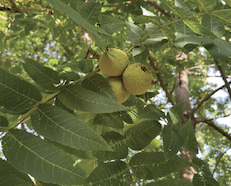
Black Walnut (Juglans nigra)
photo, Nikki Hagan
Black walnut is the native tree that is probably most often mistaken for tree-of-heaven. Like the tree- of-heaven the leaves are pinnately-compound and alternate. Leaves have 15-23 leaflets, which are narrow, and completely toothed, unlike the tree- of-heaven, which usually has only one pair of teeth at the base of each leaflet, as mentioned above. Mature trees have a distinctive bark, which is dark, deeply furrowed, and can be used to identify the species in winter months. The fruits of black walnut are nuts with large, round husks that begin as a light green color and ripen to a dark brown in early to mid- autumn. While sometimes considered a weedy species, black walnut supports a variety of native wildlife including butterflies, moths, birds, and small mammals, and thus can be an excellent native alternative to the invasive tree-of-heaven. However, it should be noted that black walnuts are allelopathic, containing the chemical juglone, which may suppress growth of some plant species in the immediate surrounding area. The nuts of the black walnut are considered toxic to pets, but can be harvested and enjoyed by humans!
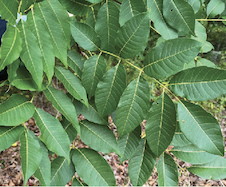
Amur corktree (Phellodendron amurense)
photo, Nikki Hagan
Another species to note is the amur corktree (Phellodendron amurense), which, like the tree-of-heaven, is native to eastern Asia and has recently become more invasive in parts of the Northeastern U.S., including Rhode Island. It has pinnately compound leaves; however, unlike the previously mentioned species, the leaves are opposite. Each leaf consists of 5 to 11 leaflets, which are entire (not toothed). Leaves are dark green, turning yellow in the fall. Like the sumacs, Amur corktree is dioecious. Flowers are yellowish and grow in clusters, turning into yellow-green fruit, which darken to black as they ripen and have a strong scent when crushed. The mature bark has a distinct spongy or corklike appearance.
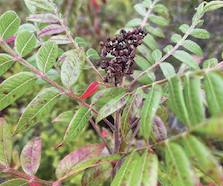
Sumacs (Rhus spp.)
photo, Nikki Hagan
The sumac genus (Rhus) has numerous members native to Rhode Island that could potentially be mistaken for the invasive tree-of-heaven due to their alternate, pinnately-compound leaves. Among these are staghorn sumac (Rhus typhina), smooth sumac (Rhus glabra), and winged or shining sumac (Rhus copallinum), each with distinct characteristics. Many of these make good alternatives to tree-of-heaven within the landscape as they can also grow in poor conditions, and are considered drought-tolerant. They will be best added to larger areas as they can grow densely, forming thickets.
Sumacs are dioecious, meaning the male and female flowers are found on different trees, and the presence of both will be needed for the formation of fruit. The species described below bear fruit that support native bird species and are edible to humans! A popular recipe is “Sumac-ade”, made by soaking crushed berries in cold water for a few hours.
• Staghorn sumac (Rhus typhina) may be found as a shrub, but can also grow quite tall with a tree-like habit. The pinnately-compound leaves have 11-31 toothed-leaflets with pointed tips. It is often recognized by its fruit which sit upright in dense clusters.
Twigs and petioles of staghorn sumac are densely covered in small hairs, which can be used to differentiate it from other species of sumacs. This species can make a good addition to the landscape, as it has an interesting aesthetic.
• Smooth sumac (Rhus glabra) can be differentiated from staghorn sumac by its smooth hairless twigs, which are instead covered by a pale waxy coating. The fruit clusters do not stand as densely upright as the staghorn sumac, and is on average smaller in size, growing in a smaller shrub-like habit.
• Shining, or winged sumac (Rhus copallinum) is so named for the glossy texture of the leaflets and the winged-midrib of the pinnately compound leaves. Like the staghorn sumac, the twigs and petioles are hairy; however, the leaflets of the winged sumac are smooth with no teeth. It makes a great addition to the landscape, and it is sometimes referred to as flameleaf sumac for its vibrant fall color!

