
Tag Archive for: ReSeeding RI
 Doug McGrady
 ReSeedingRI, photo Shannon Kingsley
The Hype about Ecotypes
This article by Shannon Kingsley first appeared in WildfloraRI, Spring 2023. Shannon Kingsley is the botanist for ReSeeding RI initative.

Ecoregion 59 seedling tray of Common
yarrow (Achillea millefolium) being grown for ReSeeding RI. photo, Shannon Kingsley
For the ReSeeding Rhode Island Initiative—RIWPS’ five-year plan to amplify native, ecotypic plants and seeds across the state—the concept of “ecotypes” is paramount. For native plant enthusiasts, it is exciting to see the availability and popularity of ecotypic seeds and plants increase. Yet, an ecotype is still a complex and oftentimes baffling concept. For starters, what exactly is an ecotype? What makes a population ecotypic? Does planting ecotypic seed increase regional biodiversity? Here, we hope to address some of these persistent questions and demystify some key evolutionary concepts to aid in our collective understanding of ecotypes.
An Ecotype is Born
In a groundbreaking paper in 1922, Swedish evolutionary botanist Göte Turesson coined the term “ecotype.” Turesson noted how environmental factors such as climate, soil, and light exposure play significant roles in establishing genetically distinct populations in a variety of plant populations. He advocated the use of a new word, ecotype, to describe these unique populations. He states that an ecotype is “an ecological unit to cover the product arising as a result of the genotypical response of an ecospecies to a particular habitat.” Simply put, Turesson thought of an ecotype as a population that is genetically adapted to a specific environment.
Over the next 100 years, scientists have expanded, shifted, and interrogated the ecotype concept within fields from ecology and evolution to genetics and virology. Today, the ecotype concept is still complex, and there does not seem to be any straight-forward guidelines for its application in scientific inquiry. Some studies apply genetic analyses to gauge ecotypic differentiation, while other studies purely focus on tracking changes in phenotypic (observable) traits over time.
Evolution and Ecotypes
The concept of an ecotype is intrinsically tied to evolution and the mechanisms that drive evolutionary change. One of the major drivers of evolutionary change is natural selection, or the process through which adaptation to environmental factors favors survival and reproduction. These adaptations are typically phenotypic (observable) traits that are inheritable, or genetically passed down to offspring.
As populations adapt and change, evolutionary change is at play. Ecotypic differentiation, or the process through which populations diverge ecotypically, is a form of natural selection. Ecotypes give rise to morphologically and genetically distinct populations of the same species so as to aid them in survival and reproduction.
For example, when we observe the salt-laden leaf blades of Spartina alterniflora (smooth cordgrass), we observe the species’ phenotypic adaptation to its saline environment. This adaptation, expressed by its genetic makeup, allows the species to expel salt from its system, thus helping it to survive in its specific environment. Now, say we find a population of Spartina alterniflora growing in a dry-mesic forest. To adapt to its drier environment, this population might have thicker leaf blades to allow for greater water storage. We may wonder whether these two populations are ecotypic. Of course, this is an extreme scenario because Spartina alterniflora does not grow in dry-mesic forests. However, the principles remain the same: ecotypes arise when populations of the same species exhibit distinct adaptive responses to varying environmental conditions.
Exploring the Ecotype
How do we know whether the population we find is truly ecotypic? Well, the truth is — we don’t, not without conducting extensive research. When we say “ecotypic seed,” we broadly refer to seeds originating from wild populations in a certain locality (or from plants whose seeds are wild-derived). For ReSeeding Rhode Island, we define an ecotype as “a population of a species that is adapted to a local environment.” We do not engage in rigorous scientific research to determine whether, for example, one population of Pycnanthemum muticum (broad-leaved mountain mint) possesses distinct genetic variation from another population of P. muticum based on environmental differences (although wouldn’t that be cool?). Instead, we operate under the assumption that Rhode Island wild-collected seeds will be best adapted to local environmental conditions and therefore have higher rates of survival when planted back into the RI landscape.
The United States Environmental Protection Agency outlines 182 “Level III Ecoregions” across North America, geographic areas grouped by factors such as topography, soil composition, and biodiversity. Ecoregion 59, or the “Northeastern Coastal Zone,” spans Rhode Island, Connecticut, Massachusetts, and southern Maine and New Hampshire. Ecoregion 59 is characterized by nutrient-poor soils, oak-pine forests, continental glacial lakes, and irregular plains. Over the last year, we collected the seeds of thirty native species from wild populations across Ecoregion 59, guided by our understanding that this ecoregion is home to ecotypic plants and therefore these seeds may possess adaptive genetic diversity.
Year 2: What’s Next for ReSeeding Rhode Island?

Wavy-leaved aster (Symphyotrichum
undulatum) seedlings sown in 2022, the first
year of the ReSeeding Rhode Island Initiative.
Photo by Shannon Kingsley.
After one year of learning, growing, and yes—adapting!—we head into the 2023 growing season with a reinvigorated
vision for ReSeeding Rhode Island. We seeded nineteen species in early January and our horticulturist, Barbara Shaughnessy, has carefully tended to these plants through the winter. In early March, a couple seedlings poked their green heads out of the chilly soil, an exciting occurrence for our eager Steering Committee members! Dave Vissoe and Brenda Woodward continue to work with RI farmers to establish founder plots where we will plant these seeded species.
This season, we plan to collect many of the same species we collected in 2022, while increasing our collection of spring-blooming species. In addition, we hope to collect the seeds of several native shrubs, including Vaccinium sp. (blueberry) and Viburnum sp. (arrowwood). We are currently expanding our educational and outreach efforts. In the meantime, follow our Instagram page (@reseedingri) to stay up-to-date on ReSeeding Rhode Island. See our ReSeedingRI homepage for more general information.

First ReSeeding Rhode Island Seedlings Head to New Homes
We begin to deliver our plugs to our organic farm and land trust partners.
 Frank Carini/ecoRI news
Plant Society Cultivates Wild Initiative to Reseed Rhode Island
Frank Carini, ecoRI news, recently interviewed Sue Theriault, chair of ReSeeding Rhode Island Initiative and Shannon Kingsley, RIWP’s botanist about this initiative. Read this article, published March 3, 2023.
 shannon Kingsley
Our Botanist in the Field
– This story and photos by Shannon Kingsley first appeared the the RIWPS publication WildfloraRI, Winter 2022
A calm, September Sunday afternoon finds me waist-deep in the leech-filled waters of the Wood River, searching for the inconspicuous Allegheny monkey- flower (Mimulus ringens). Among Joe-Pyes (Eutrochium spp.) and some late-blooming cardinal flower (Lobelia cardinalis), the monkey-flower has shed its light purple flowers for lime-green seed pods. Slicing through a pod with a small pocket knife, I find the tiny rust-colored seeds packed into the walls of the carpel, like a sugar cone jammed full of ice cream. These teeny lives hold such potential, such life bursting at each pod’s green seams.
Using a tallying app on my phone, I begin to count every individual that I see, wading along the shore and recording each one through a simple click. As I observe each plant, I make mental notes: no visible insect damage, pods still green. Once I tally fifty plants on the app — the minimum population size for sustainable collecting — I record my observations in my field notebook. I also collect seeds of the cardinal flowers, their pods brown and dry, held upright on their stems, the opening of the pod sheltered by the wilted calyx. Sporting its red flowers like funky party hats, this colorful species is an important nectar source for hummingbirds, which in turn, spread its pollen to neighboring flowers.
Monkey-flower and cardinal flower serve as crowning examples of the mission of the Rhode Island Wild Plant Society’s ReSeeding Rhode Island initiative: to increase both native plant populations and their pollinators across the state. While monkey-flower serves as a host plant for native butterfly species, including Baltimore Checkerspots and the Common Buckeye, cardinal flower attracts hummingbirds, bees, and moths.
The project began with a list of approximately thirty-two species, many of them known for both attracting pollinators and tolerating sunny, dry conditions. Some exceptions include species that prefer wetter conditions, such as the monkey-flower and cardinal flower, and several grass species that serve more of an ecological role, such as improving soil stability and providing bird and insect habitats. Although RIWPS has a target list of ‘most-wanted’ species, our species list is mutable.
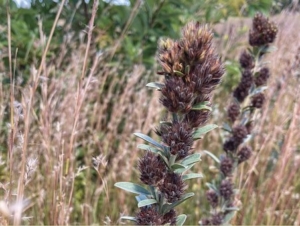
Bushy clover with little bluestem, photo Shanon Kingsley
Our collections ultimately depend on the availability of these seeds in the wild and the sustainability of the target populations. As the project unfolds, I find myself shuttling from the blistering fields of Carter Preserve in Charlestown, to the squishy water’s edge of Browning Mill Pond in Arcadia; I have searched along the wooded paths of Cumberland Land Trust, and explored the varied topographies of private landowner property.
With each new site, I approach my work with a similar mentality: I am a citizen of this natural space, and this work requires an intentional, reciprocal relationship to the land and its inhabitants. To this end, I follow the Seeds of Success (SOS) protocol, a publicly accessible document produced by the Bureau of Land Management that outlines the responsibilities of collecting wild seeds. Some of these regulations include collecting plants from populations with more than fifty individuals and collecting no more than twenty percent of the population’s seeds on any given day. Additionally, I must return to the same population of a specific species to collect seeds two or three times per season in order to maximize genetic diversity within the collected population. I also evaluate the health of the population throughout the season to monitor how insect damage or negative environmental conditions, such as extreme drought or heat, affect seed production.
Additionally, it is important we remember and give honor to the indigenous people who first stewarded this land upon which RIWPS now collects seeds. These tribes include the Narragansetts, the Niantics, the Pequots and the Pokanokets. I spend considerable time researching public lands and networking with local environmental stewards who know the histories of public lands across Rhode Island. I determine wild status through learning about the history of different lands from professionals within the Rhode Island Department of Environmental Management (RIDEM), local stewards of various land trusts, and private landowners. On numerous occasions, I have been disappointed to learn that a promising population I found was in fact seeded for restoration purposes. Although it is amazing that much of Rhode Island’s public lands have been restored and seeded to improve ecosystem health and to aid wildlife, these sites pose a challenge for finding “truly” wild populations.
For each site where I find a healthy, sizable population from which to collect seeds, I gain official written or verbal permission from the managers of the site and confirm its wild status. I collect seeds from sites managed by various organizations within Rhode Island, including RIDEM, The Nature Conservancy, Norman Bird Sanctuary, Warren Land Conservation Trust, and Westerly Land Trust. There is also a rigorous documentation aspect of the project which aligns with the project’s goal of utilizing a data-driven approach to this work.
This documentation starts in the field with comprehensive field notes and systematic collections of both seed and voucher specimens. In alignment with SOS Protocols, I collect one to two voucher specimens per species at the site of seed collection for documentation and herbaria accession purposes. I also record exact GPS coordinates for each voucher and seed collection. With this coordinate data, I create an interactive map through Rstudio, software that accommodates R computer programming for data science and visual scientific communication. The continual mapping of sites and species across the state helps visualize the spread of our collections, especially as we aim to collect from all three subregions of Ecoregion 59.
As of late summer, I am seed- deep in collections. I have collected approximately 20 species of seeds, including notable pollinator plants such as common yarrow (Achillea millefolium), licorice-scented goldenrod (Solidago odora), and narrow-leaved mountain mint (Pycnanthemum tenuifolium). As autumn unfolds, I plan to collect several late-seeding species, including wavy-leaved aster (Symphyotrichum undulatum), bushy bluestem (Andropogon glomeratus), and blue-stemmed goldenrod (Solidago caesia).
Seed cleaning is another important step in this project, and this process varies depending on the cleaning requirements for each species. For some species, such as bladder-pod lobelia (Lobelia inflata), it is as simple as splitting the seed pod and emptying the seeds into a small paper bag for storage. For others, it requires the use of screens and sifters to separate the seed from its pappus, or the feathery tuft attached to the seed, as in the case of goldenrod (Solidago) species.
From the barely perceptible seeds of blue vervain (Verbena hastata) to the trigger-spring seed explosions of wild geranium (Geranium maculatum), the silky parachutes of swamp milkweed (Asclepias incarnata) and velvety tear drops of round-headed bush clover (Lespedeza capitata), it is a transformative experience to be responsible for the collection of such varied and intricate life forces. Especially during the uncertainty of the global climate crisis, it is more imperative than ever to remember the importance of aiding in the proliferation of native plants and the pollinators that depend on them.